Good Works!: Marketing and Corporate Initiatives that Build a Better World...and the Bottom Line by Philip Kotler & David Hessekiel & Nancy Lee
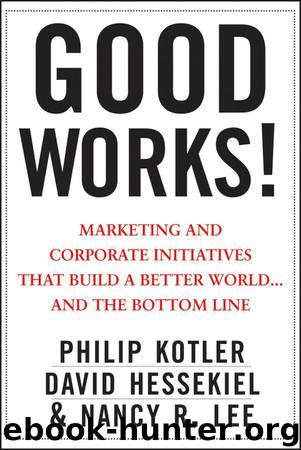
Author:Philip Kotler & David Hessekiel & Nancy Lee [Kotler, Philip]
Language: eng
Format: mobi
Publisher: Wiley
Published: 2012-05-21T14:00:00+00:00
Case #1: Pepsi Refresh—Creating Community Good Will and National Attention
When Indra Nooyi became CEO of PepsiCo in 2006, she promised herself that she would make PepsiCo “into one of the most responsible companies in the world.”9 The direction she set for the company was captured in three words: Performance with Purpose.
Impressed by research that showed, “Consumers liked brands that possessed a soul—brands that had warmth and stood for purpose,”10 Nooyi encouraged PepsiCo's marketing leaders to explore adding new, socially conscious dimensions to the company's $19 billion-plus brands.
The Pepsi brand marketing team developed a groundbreaking, purpose-driven initiative called the Pepsi Refresh Project born from the concepts that each generation wants to refresh the world and that social media presented exciting opportunities to engage consumers.
In the fall of 2009, the company announced that it would forego its traditional multimillion-dollar investment in Super Bowl advertising and redirect those funds into a campaign that would award $20 million in grants ranging from $5,000 to $250,000 to social projects nominated by and voted upon by the public via digital and social media.
Far from a traditional corporate philanthropy effort, Pepsi Refresh was in the vanguard of crowd-sourced giving. Consumers and nonprofit groups were given a central role in nominating pro-social ideas and enlisting others via social media to vote for them. In the case of Pepsi Refresh, the entire program—including all of the grants—was funded out of the Pepsi marketing budget.
As Nooyi explained in a March 2011 TED Talk:11
[E]very month we accepted 1,000 projects that people could vote on. During the first month, we were worried whether we were going to get 1,000 projects, but, incredibly, we got it in about 17 hours. In the second month, we got 1,000 projects in 17 minutes. By the third month, 17 seconds after the project lines opened, we had 1,000 videos, and there were tens of thousands of grants waiting to be submitted. We were tapping into something in the world that felt good.
The projects that came in were all so unbelievable and emotionally heart-wrenching because, for $5,000 or $10,000, you could make a huge difference in society. But let me tell you the magnitude of the numbers. There were 183,000 ideas that were started, and $20 million was awarded to 1,000 grantees. There were 84 million votes cast, $65 million of media coverage came from that project; 48 new organizations were started and 108 schools were improved.
The ambitious campaign experienced some technical snafus and generated criticism that it had inadequate safeguards against voting fraud,12 but it clearly succeeded in getting people talking about Pepsi as a socially conscious brand. Consumers ranked Pepsi number one as a brand “that comes to mind as placing as much or more importance on supporting a good cause as they place on profits” in a fall 2010 survey by Edelman PR.13
Some beverage industry analysts dubbed Pepsi Refresh a failure because Pepsi lost market share to Coca-Cola in 2010.14 Responding to that criticism, Shiv Singh, head of digital for PepsiCo Beverages America, told
Download
This site does not store any files on its server. We only index and link to content provided by other sites. Please contact the content providers to delete copyright contents if any and email us, we'll remove relevant links or contents immediately.
Influence: The Psychology of Persuasion by Robert B. Cialdini(4800)
The Miracle Morning by Hal Elrod(4734)
The Hacking of the American Mind by Robert H. Lustig(4387)
Pre-Suasion: A Revolutionary Way to Influence and Persuade by Robert Cialdini(4236)
Unlabel: Selling You Without Selling Out by Marc Ecko(3668)
Ogilvy on Advertising by David Ogilvy(3630)
Hidden Persuasion: 33 psychological influence techniques in advertising by Marc Andrews & Matthijs van Leeuwen & Rick van Baaren(3570)
Purple Cow by Seth Godin(3208)
Who Can You Trust? by Rachel Botsman(3136)
Kick Ass in College: Highest Rated "How to Study in College" Book | 77 Ninja Study Skills Tips and Career Strategies | Motivational for College Students: A Guerrilla Guide to College Success by Fox Gunnar(3132)
The Marketing Plan Handbook: Develop Big-Picture Marketing Plans for Pennies on the Dollar by Robert W. Bly(3070)
This Is Marketing by Seth Godin(3040)
I Live in the Future & Here's How It Works by Nick Bilton(3002)
The Power of Broke by Daymond John(2992)
The Tipping Point by Malcolm Gladwell(2931)
Building a StoryBrand by Donald Miller(2918)
The 46 Rules of Genius: An Innovator's Guide to Creativity (Voices That Matter) by Marty Neumeier(2859)
Draw to Win: A Crash Course on How to Lead, Sell, and Innovate With Your Visual Mind by Dan Roam(2789)
Market Wizards by Jack D. Schwager(2705)
